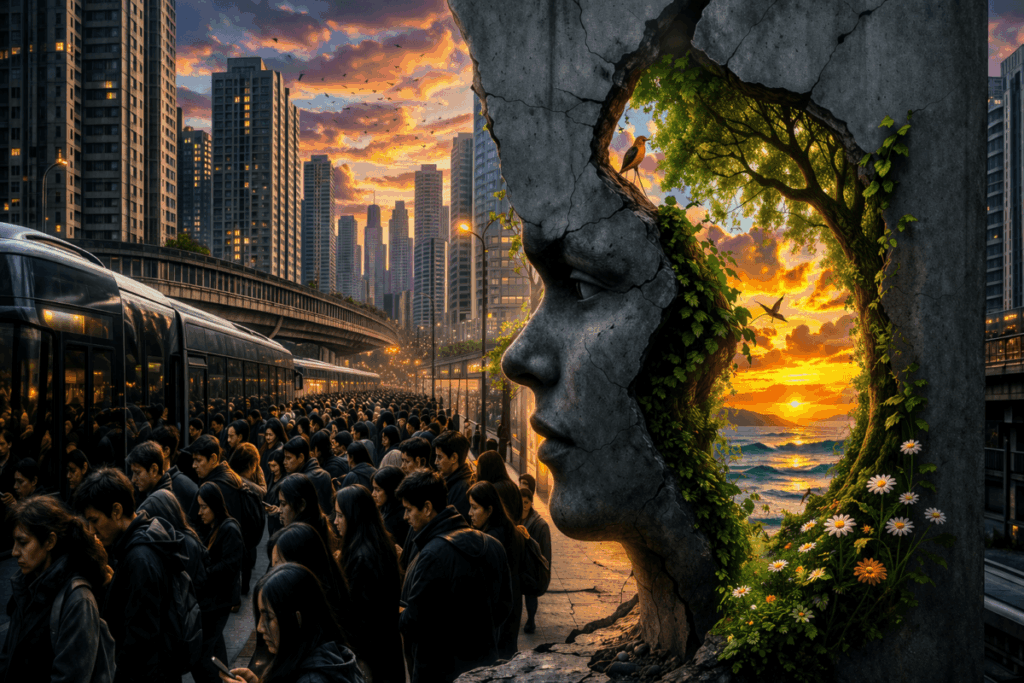
If you pay attention to people on the metro or bus rapid transit during rush hours in Istanbul, you may have noticed it: a certain numbness, a coldness framed by high-rise residences. A mechanical crowd, where people seem to have dissolved into it—so physically close, yet so distant. Physical contact is inevitable, yet emotional contact—curiosity, recognition, sharing—is absent. In a world of concrete, where people rush to get somewhere and machines occupy more space than humans, we no longer look into each other’s eyes; instead, we track elevators, vehicles, parking spots. So what lies beneath this numbness?
Ecological Grief and Anxiety
In recent years, the concept of ecological grief has gained attention in psychological literature. It refers to the grief we experience in response to irreversible losses in nature. The pain we feel during forest fires is not isolated; it is part of a broader, ongoing loss—species extinction, climate instability, melting glaciers, and the pollution of soil, water, and air.
Ecological anxiety, on the other hand, is the chronic sense of worry—conscious or unconscious—about these losses and the disasters yet to come. The deterioration of nature and agriculture, threats to our health, drought, natural disasters, the possibility of cities being submerged… Alongside these global concerns, the mucilage crisis in the Sea of Marmara has recently made the fear of losing marine life painfully tangible.
In such moments, the anxiety and grief we feel are not pathological. On the contrary, they are meaningful responses of a psyche that recognizes loss and danger—an inner signal that something is not right.

Holding Environment: Winnicott
The relationship between human beings and their environment brings to mind the concept of the holding environment, introduced by child psychoanalyst D. W. Winnicott. Human infants are born more vulnerable than any other species; yet through the physical and emotional containment of a caregiver, they begin to experience, understand, and regulate their inner world.
What the infant needs is a safe, reliable, and nurturing environment. Like the womb, and later through the caregiver’s touch, voice, and presence, the baby is held and soothed. This relationship is reciprocal—there is a resonance, a sense of attunement between caregiver and infant. It is continuous and predictable. In its absence, intense anxiety and insecurity emerge; when emotions become overwhelming and uncontainable, numbness and alienation may follow.
We do not experience this sense of being held only with our caregivers, but also with Mother Nature. The rhythm of day and night, the cycles of the seasons, the continuity of nature—like a trusted caregiver—offer us a sense of safety. Being in contact with nature, much like the presence and touch of a mother, soothes the body, regulates our internal rhythms, and reconnects us with ourselves.
Doesn’t entering the sea feel like being held again in the fluid of the womb? The branches of lush green trees resemble embracing arms—offering safety while reminding us of our own capacity to hold. Their roots remind us of our own roots and connections, like the elders we call “ancient plane trees.” We remember where we come from; we anchor ourselves in life, we find our place.
With the arrival of spring, nature’s awakening mirrors the changes of adolescence—reviving vitality and creativity within us. Nature’s cycles speak of endings, beginnings, transformation, and hope. In other living beings, we witness what already exists within us: competition, struggle, the instinct to protect oneself, to flee if necessary, to persist in life. Watching a young bird gradually learn to fly under the watch of its mother, eventually becoming independent, echoes the slow process of human separation and individuation.
Disconnection: Urbanization and the Climate Crisis
Yet urbanization and the climate crisis disrupt not only nature, but also our relationship with our own nature. Just as the felt attunement between mother and infant can be broken, so too is the harmony and identification we share with the natural world.
The loss of this contact, rhythm, and continuity leaves behind a quiet alienation—numbness, persistent anxiety, sadness, and a sense of being trapped.
This is why the grief we carry is not only for the loss of nature, but for the loss of that holding, containing, and meaning-giving space itself. And perhaps those expressionless faces we see on the metro and buses are silent, unnamed reflections of this unheld grief.
References:
Winnicott, D. W. (1965). The Maturational Processes and the Facilitating Environment.